

Neurodiversity News | July 2026

July 2026 Neurodiversity Newsletter Issue #10 The July 2026 Neurodiversity Newsletter (Issue No. 10) is presented as a practical and supportive summer roundup for neurodivergent individuals, families, and professionals. It brings together articles on ADHD, autism, time management, summer routines, self-care, assessment guidance, community updates, and upcoming learning opportunities. Please click this button to find the PDF of the latest issue. READ THE LATEST ISSUE Welcome and overall focus In this issue, readers are invited to explore how changes in routine, time blindness, executive functioning, sensory needs, and self-care can shape summer experiences for neurodivergent individuals. The publication highlights practical tools, lived experiences, assessment resources, community programs, and upcoming events across the Adult ADHD Centre, Adult Autism Centre, B.E.S.T. Membership Program, Disability Team, and ADHD Training Academy. “The Invisible Disability of ADHD” The featured article, “The Invisible Disability of ADHD,” by Naïma Laraki, explores time blindness and why managing time can be especially difficult for people with ADHD. The article shares practical strategies such as breaking tasks into smaller steps, allowing extra time, creating a master list, scheduling tasks in a calendar, setting priorities, and delegating when possible. It also explains that time management is often connected to executive functioning, motivation, attention, and energy management. “Lessons From Sports on How to Create Neurodiverse Game Plans” The featured article, “Lessons From Sports on How to Create Neurodiverse Game Plans,” by Andrea Dasilva, Registered Clinical Counsellor, explores what sports can teach us about supporting neurodivergent needs. Andrea discusses how movement, teamwork, clear expectations, structured routines, rest, and smaller goals can support focus, emotional regulation, motivation, connection, and follow-through. Readers are encouraged to create their own practical game plans based on their needs and strengths. Summer is not always easier The issue explores why summer can feel challenging for people with ADHD and autism when familiar school, work, and daily routines change. Readers are encouraged to maintain flexible structure through consistent sleep and meal routines, visual schedules, reminders, planned downtime, sensory breaks, and realistic expectations. The article emphasizes that summer does not need to be rigid, but a little structure can make daily life feel more manageable. AuDHD: When ADHD and autism coexist The July issue introduces AuDHD, a community-used term describing the experience of having both ADHD and autism. The article explains how ADHD and autism can interact and sometimes create needs that appear to pull in different directions. Recognizing this overlap may help individuals better understand their experiences, reduce self-judgment, and identify supports that reflect their complete needs. Community updates and partner programs The newsletter includes community updates and highlights educational opportunities available through partner organizations. Featured programs include Understanding ADHD for Adults, an online education program for newly diagnosed adults, and Understanding Your Child’s ADHD, a program for parents of newly diagnosed children. The issue also features the upcoming Embracing Change: Supporting ADHD & LD Across Life Transitions conference. Summer strategies and self-care tips The July issue provides practical tools for creating a more supportive summer. Featured strategies include maintaining loose routines, preparing for transitions, supporting physical wellbeing, managing sensory stimulation, planning ahead, reducing overwhelm, and practising self-compassion. The AuDHD self-care guide also encourages readers to honour their energy, regulate before responding, create flexible routines, meet sensory needs, and make time for meaningful interests. Assessments, programs, and support resources The July issue features several pathways for readers seeking assessment, education, or structured support. The Adult ADHD Centre provides information about private adult ADHD assessments. The Adult Autism Centre supports individuals exploring adult autism assessments. The issue also highlights the B.E.S.T. Membership Program, Disability Tax Credit resources through the Disability Team, and professional learning through the ADHD Training Academy. Upcoming webinars and learning opportunities The newsletter includes a full calendar of July events focused on autism genetics, artificial intelligence and executive functioning, ADHD summer routines, the Disability Tax Credit, shame, self-esteem, and self-compassion. These learning opportunities are designed to provide individuals, families, professionals, and community members with practical information and supportive strategies. Team recognition and staying connected The newsletter concludes by recognizing the team members and contributors who helped create the July issue. Readers are encouraged to stay connected with the Adult ADHD Centre and its partner organizations for future resources, assessments, programs, events, and updates. SUBSCRIBE TO OUR NEWSLETTER
Neurodiversity News | June 2026
June 2026 Neurodiversity Newsletter Issue #9 The June 2026 Neurodiversity Newsletter (Issue No. 9) explores understanding, acceptance, and meaningful support for neurodivergent individuals. This issue brings together practical ADHD strategies, mental health education, assessment information, community resources, and learning opportunities from across our organizations. Please click this button to find the PDF of the latest issue. READ THE LATEST ISSUE Welcome and Overall Focus This edition emphasizes understanding, acceptance, and individualized support within the neurodiverse community. Readers are invited to explore practical tools, educational resources, and professional services designed to strengthen wellbeing and help people feel supported throughout different stages of their journey. “Body Doubling and ADHD: Why Working Beside Someone Can Help” The research spotlight explores body doubling, an ADHD support strategy in which another person works nearby, either in person or virtually, to provide structure, presence, and accountability. The article offers practical ways to try body doubling, including choosing one clear task, setting a short time limit, reducing distractions, using quiet presence, and reflecting on what helped. It also explains how this strategy may support focus and task initiation as routines change during the summer. Featured Article: “Shattered” In “Shattered,” Andrea Dasilva, Registered Clinical Counsellor, explores how distressing experiences can affect the nervous system, emotions, memory, relationships, and everyday functioning. The article explains different responses to trauma and emphasizes that recovery is possible. It also discusses how professional support and evidence-informed approaches can help individuals process difficult experiences, rebuild connection, and move forward. Take the 2-Minute Quiz Readers are invited to complete a brief reflective quiz exploring the types of support that may help them feel their best during the season. The quiz is intended for reflection and is not a diagnostic tool. Assessments, Programs, and Support Resources The June issue highlights several pathways for individuals seeking assessment, education, and ongoing support. The Adult ADHD Centre shares information about inclusive care and comprehensive adult ADHD assessments. The B.E.S.T. Membership Program introduces practical, skills-based support for adults with ADHD, while the ADHD Training Academy offers professional training for people working in healthcare, education, counselling, coaching, human resources, and community services. The Adult Autism Centre outlines the path toward an adult autism assessment and offers a free 30-minute consultation for individuals seeking guidance about their next steps. The Disability Team also provides information about Disability Tax Credit eligibility and how eligibility is based on the functional impact of an impairment rather than diagnosis alone. Adult Autism Webinar The newsletter features the June 2026 Adult Autism Webinar with Dr. Gurdeep Parhar, Andrea Dasilva, and Dr. Anita Parhar. The session focuses on adult autism, sensory experiences, self-care, and support, giving participants an opportunity to learn from experienced professionals and deepen their understanding of autism in adulthood. Upcoming Events and Learning Opportunities The June issue includes upcoming educational events focused on ADHD, physical health, the Disability Tax Credit, and the Registered Disability Savings Plan. These sessions are designed to help individuals and families better understand available resources, financial supports, and practical strategies for managing everyday challenges. Resource of the Month The featured book is The Trauma of Money by Chantel Chapman, a resource exploring the connections between money, healing, financial trauma, and financial shame. Team Recognition and Staying Connected The newsletter concludes by recognizing the team members and contributing writer who helped bring the issue together. Readers are encouraged to stay connected with the Adult ADHD Centre and its partner organizations for future articles, assessments, programs, events, and neurodiversity resources. SUBSCRIBE TO OUR NEWSLETTER
Neurodiversity News | May 2026
May 2026 Neurodiversity Newsletter Issue #8 The May 2026 Neurodiversity Newsletter (Issue No. 8) is presented as a warm, informative roundup that supports neurodivergent individuals, families, and professionals as spring moves toward summer. It brings together practical strategies, mental health reflection, assessment guidance, community updates, and learning opportunities focused on ADHD, autism, neurodivergent wellbeing, and accessible support. Please click this button to find the PDF of the latest issue READ THE LATEST ISSUE Welcome and overall focus In this issue, readers are invited to explore how seasonal transitions, mental health, support systems, and assessment resources shape everyday life for neurodivergent individuals. The publication highlights lived experiences, practical tools, and upcoming learning opportunities, while continuing to emphasize collaboration across the Adult ADHD Centre, Adult Autism Centre, ADHD Training Academy, CADDAC, and the BEST Program. “Spring, Stress, and ADHD: How to Reset Before Summer” The research spotlight, “Spring, Stress, and ADHD: How to Reset Before Summer,” explores how the end of the school year can increase stress for students, families, parents, and adults with ADHD. Final assignments, exams, changing schedules, and the transition into summer can all place extra pressure on executive functioning. The article explains that ADHD is closely tied to challenges with planning, organization, emotional regulation, and transitions. It highlights simple supports such as reviewing remaining deadlines, reducing unnecessary pressure, keeping basic routines steady, preparing for summer changes early, and building in recovery time. “Someone to Lean On” The featured article, “Someone to Lean On” by Andrea Dasilva, Registered Clinical Counsellor, explores the connection between mental health, physical health, and neurodivergent wellbeing. The article reflects on how physical health concerns are often easier to recognize, while mental health experiences can be more complex, longer lasting, and harder to explain. From a neurodivergent lens, experiences such as masking, stigma, burnout, loneliness, isolation, and overwhelm can add further layers of difficulty. Andrea encourages readers to give mental health greater priority, build awareness of helpful regulation strategies, and reach out for support through friends, family, coworkers, online groups, and affirming communities. CADDAC conference call for submissions The issue also highlights CADDAC’s call for speaker proposals for the upcoming 18th Annual ADHD Conference at Centennial College in Scarborough, Ontario. ADHD experts, allied healthcare professionals, educators, researchers, and people with lived experience are invited to share insights, research, and knowledge with the broader ADHD community. Assessments, programs, and support resources The May issue features several pathways for readers seeking assessment, education, or structured support. The Adult Autism Centre section directs readers to learn more about adult autism assessments and understanding autism in adulthood. The Adult ADHD Centre section promotes private adult ADHD assessments for individuals seeking clarity and next steps. The issue also highlights the BEST Program, Disability Tax Credit resources, and professional learning through the ADHD Training Academy. Upcoming webinars and learning opportunities The newsletter includes a full calendar of upcoming events focused on ADHD, autism, sensory processing, emotional regulation, finances, and the Disability Tax Credit. Featured topics include ADHD and gender, ADHD and exercise, emotional dysregulation, sensory processing, debt repayment, mental health and physical health conditions related to the DTC, and autism awareness sessions. Team recognition and staying connected The newsletter concludes by encouraging readers to stay connected with the Adult ADHD Centre and its partner organizations for future resources, events, and updates. SUBSCRIBE TO OUR NEWSLETTER
Neurodiversity News | April 2026
April 2026 Neurodiversity Newsletter Issue #7 This edition of Neurodiversity News highlights autism, ADHD, and the diverse experiences of neurodivergent individuals across the lifespan. In April, we are focusing on autism in Canada through the lens: moving beyond awareness toward recognition, inclusion, and meaningful support. Our goal remains to inform, support, and strengthen understanding across the communities we serve. Please click this button to find the PDF of the latest issue READ THE LATEST ISSUE Welcome This edition of Neurodiversity News highlights autism, ADHD, and the diverse experiences of neurodivergent individuals across the lifespan. In April, we are focusing on autism in Canada through the lens: moving beyond awareness toward recognition, inclusion, and meaningful support. Our goal remains to inform, support, and strengthen understanding across the communities we serve. April – Autism Acceptance Month The first featured article, “April – Autism Acceptance Month” by Andrea Dasilva, explores how autism has evolved from being misunderstood to being recognized as a valid and meaningful way of being. It reflects on the shift from deficit-based thinking toward a neurodiversity-affirming perspective that values individuality and lived experience. The article highlights the importance of identity-first language, individualized support, and environments that adapt to the person rather than forcing conformity. It also emphasizes the role of acceptance, inclusion, and listening to autistic voices in building a more supportive society. ADHD & Tax Returns: Don’t Get Trapped This Year Another featured article by Naïma Laraki explains why tax filing can be especially challenging for individuals with ADHD. It frames the difficulty as a challenge of executive functioning and self-regulation rather than intelligence or effort. The section outlines key barriers such as planning, document organization, time management, sustained attention, and completing long, unstimulating tasks. It also provides practical strategies including breaking tasks into smaller steps, using a body double, working in short intervals, creating accountability, and reducing perfectionism. When Emotional Chaos Takes Over: Heart Coherence and the CUT-TRU Method to Navigate ADHD More Calmly Within the same feature, this section focuses on emotional regulation in ADHD. It explains that ADHD is not just about attention, but also about how quickly and intensely emotions can activate. Heart-focused breathing is introduced as a way to regulate the nervous system and create a sense of calm. The CUT-TRU method provides a structured approach: calming the body, understanding internal experiences, taking ownership, and choosing a more aligned response. Neurodivergent Celebration Week This section highlights Neurodivergent Celebration Week and the importance of recognizing and celebrating neurodivergent identities. It focuses on increasing visibility, reducing stigma, and creating spaces where individuals feel seen, valued, and supported. Adult Autism Centre The Adult Autism Centre section highlights a supportive Autism Acceptance Month invitation for adults who have questions about autism assessments. It encourages readers to book a complimentary free 30-minute discussion about the autism assessment as a first step to learn more about the process and explore what feels right for them. ADHD Training Academy The ADHD Training Academy section shares an important update that the ADHD-CEPP™ trademark application is approved. It explains that this brings more confidence to a certification pathway designed to support high standards in ADHD learning and practice, and invites readers to begin the 12-module certification process. BEST Program – community for adults with ADHD The Bold Education Skills Treatment (BEST) Program is presented as a welcoming, judgment-free community for adults with ADHD. Delivered entirely online, it includes two monthly webinars on topics such as sleep, medication, impulse control, organization, and focus, along with opportunities for members to connect, share experiences, and support one another. April 2026 events and webinars The April newsletter includes educational webinars focused on ADHD, autism, and mental health. These sessions provide practical guidance, expert insights, and opportunities for participants to learn and engage. Each event includes details on topics, timing, and registration, continuing the newsletter’s focus on accessible education and community support. Explore Upcoming Sessions Team recognition and staying connected The newsletter concludes by encouraging readers to stay connected with the Adult ADHD Centre and its partner organizations for ongoing resources, updates, and events. SUBSCRIBE TO OUR NEWSLETTER
Neurodiversity News | March 2026
March 2026 Neurodiversity Newsletter Issue #6 This publication celebrates, supports, and empowers neurodivergent individuals and their communities. Each edition explores insights into ADHD, autism, and other neurodiverse experiences; highlights valuable resources and advocacy updates; and shares stories that reflect lived experiences. Our goal remains to raise awareness, promote inclusion, and provide meaningful information for individuals, families, and professionals. We are excited to continue learning, sharing, and growing together. Please click this button to find the PDF of the latest issue READ THE LATEST ISSUE Welcome and overall focus In this issue, readers are invited to explore neurodiversity in real-world environments, including workplaces, performance, and everyday functioning. The publication highlights how different ways of thinking contribute to creativity, innovation, and resilience, while continuing to emphasize support, inclusion, and education across the Adult ADHD Centre and its programs. Neurodiversity at Work The first featured article, “Neurodiversity at Work” by Andrea Dasilva (Registered Clinical Counsellor), explores how neurodivergent individuals think, learn, and process information differently, and how these differences bring valuable perspectives to the workplace. It highlights that while neurodivergent individuals are ready and willing to work, they are often misunderstood or underrepresented. The article explains the concept of neurodiversity as a shift away from deficit-based thinking toward recognizing natural variations in the human brain. It emphasizes that diverse neurotypes bring originality, innovation, and unique strengths that can enhance team performance and workplace culture. It also discusses how workplace challenges can be reframed through a strengths-based lens. Traits such as hyperfocus, sensitivity, and time perception differences can contribute to precision, creativity, and accountability when supported appropriately. Practical strategies include workplace adaptations such as noise-cancelling headphones, adjusted lighting, structured schedules, movement breaks, and flexible environments. The article also highlights the right to reasonable accommodations in Canada and the importance of choice around disclosure. Overall, it reinforces that when environments are supportive, neurodivergent individuals can thrive and contribute meaningfully. Research Spotlight of the Month This section highlights the connection between neurodiversity and performance, using the example of elite athletes. As Canada prepares for the 2026 Winter Olympics, the spotlight emphasizes how success is supported by structure, coaching, and consistency, not just talent. It explores how many athletes openly live with ADHD, showing that neurodiverse traits can exist alongside high performance. Research from the University of Calgary suggests that traits such as high energy, hyperfocus, and quick problem-solving can align with the demands of competitive sport. The section reinforces that neurodiversity represents natural differences in thinking and processing, and that success comes from creating environments where these differences are supported. With the right systems in place, neurodivergent individuals are able not only to cope, but to perform, contribute, and excel. Trauma of Money – Spring 2026 Cohort This section introduces the Trauma of Money (TOM) Professional Pathway, a certification program designed for professionals who want to integrate financial trauma-informed approaches into their work. The program focuses on reducing shame and increasing awareness around financial behaviours and decision-making. The Spring 2026 cohort runs from March 4 to June 30, with sessions scheduled across different times to support accessibility. The course offers structured learning, practical tools, and a compassionate framework for understanding the relationship between money, stress, and emotional wellbeing. Team recognition and staying connected The newsletter concludes by encouraging readers to stay connected with the Adult ADHD Centre and its partner organizations for future resources, events, and updates. SUBSCRIBE TO OUR NEWSLETTER
Neurodiversity News | February 2026
February 2026 Neurodiversity Newsletter Issue #5 The February 2026 Neurodiversity Newsletter (Issue No. 5) is presented as a warm, informative roundup that celebrates, supports, and empowers neurodivergent adults and their communities. It brings together lived-experience stories, practical strategies, assessment guidance, and professional learning opportunities focused on ADHD, autism, and neuro-affirming care. Please click this button to find the PDF of the latest issue READ THE LATEST ISSUE Welcome and overall focus In this issue, readers are invited to explore how ADHD shows up in everyday life, including workplace dynamics, emotional regulation, and relationships. The publication highlights lived experiences, practical strategies, and learning opportunities, while continuing to emphasize collaboration across the Adult ADHD Centre, Adult Autism Centre, ADHD Training Academy, and the BEST Program. “ADHD and Management Models” The first featured story, “ADHD and Management Models” by Naïma Laraki (MSc, CPCC, PCC, MCAC), explores how traditional workplace expectations often do not align with how ADHD brains function. Systems built around consistency, rigid schedules, and linear productivity can create barriers rather than support.The article explains that focus in ADHD is not constant but occurs in waves, shaped by interest, stimulation, and emotional safety. It highlights how energy management plays a more critical role than time management, and how outcome-based approaches, flexible workflows, and supportive leadership can better support neurodivergent individuals. “Dopamine Menu” The second featured story, “Dopamine Menu” by Andrea Dasilva (MEd, RCC), explores the role of dopamine in ADHD and how it affects motivation, behaviour, and emotional regulation. Lower dopamine levels can lead to impulsive behaviours and a constant search for stimulation.The article introduces the idea of creating a personalized “dopamine menu” to support regulation. Activities are organized into categories such as quick boosts, longer activities, supportive add-ons, and occasional indulgences. This approach helps reduce overwhelm and makes it easier to choose supportive actions during moments of low energy or dysregulation. Building lasting friendships with ADHD Another major feature, “Building Lasting Friendships with ADHD,” focuses on how ADHD can impact relationships. It explains that challenges with consistency, time awareness, and emotional regulation can create friction, even when connection and care are strong. The section highlights patterns such as time blindness, working memory challenges, and rejection sensitivity, which can lead to misunderstandings or withdrawal. It emphasizes that these are neurological patterns rather than personal shortcomings.Practical strategies include using external supports, simplifying communication, and focusing on relationships that are reciprocal and sustainable. The article reinforces that meaningful, lasting friendships are possible when connection is shaped around how the ADHD brain works. Team recognition and staying connected The newsletter concludes by encouraging readers to stay connected with the Adult ADHD Centre and its partner organizations for future resources, events, and updates. SUBSCRIBE TO OUR NEWSLETTER
Neurodiversity News | January 2026
January 2026 Neurodiversity Newsletter Issue #4 This publication celebrates, supports, and empowers neurodivergent individuals and their communities. Each edition explores insights into ADHD, autism, and other neurodiverse experiences, while highlighting resources, advocacy, and real-life stories. The goal is to raise awareness, promote inclusion, and provide meaningful support for individuals, families, and professionals. Please click this button to find the PDF of the latest issue READ THE LATEST ISSUE Welcome and overall focus In this issue, readers are invited to reflect on how sleep, movement, sensory regulation, and community shape everyday life for neurodivergent adults. The publication highlights offerings from the Adult ADHD Centre, Adult Autism Centre, ADHD Training Academy, and the Bold Education Skills Treatment (BEST) Program, emphasizing collaboration across these services. “Tired But Wired” – ADHD and sleep The first featured story, “Tired But Wired” by Marlee Boyle (BSc, RRT, CCSH), explores the complex relationship between ADHD and sleep. It explains how sleep disruption can intensify difficulties with attention, memory, and emotional regulation, creating a cycle of exhaustion and worsening symptoms. The article introduces two key processes: sleep pressure and circadian rhythm. Many adults with ADHD feel most alert late at night, which can lead to racing thoughts at bedtime and mornings that begin already fatigued. It also explains how CBT-I, consistent routines, and practical sleep strategies can help support better rest Neurodiversity Playlist The second featured story, “Neurodiversity Playlist” by Andrea Dasilva (MEd, RCC), highlights music as an accessible and validating tool for emotional regulation, focus, and wellbeing. It explores how different types of music can support concentration, attention, memory, and motivation. Andrea also reflects on how music can create calm, reduce stress, improve self-esteem, and help people feel understood and connected. Readers are encouraged to see music as a personal and year-round support for regulation and self-compassion. Managing Seasonal Affective Disorder Another major feature, “Seasonal Affective Disorder & How To Manage It,” focuses on how winter changes can affect mood, energy, motivation, and daily functioning, especially for neurodivergent adults. It explains how reduced daylight, disrupted routines, and seasonal stress can intensify low mood, anxiety, fatigue, and sensory overwhelm. The piece offers supportive strategies such as light therapy, maintaining simple routines, movement, balanced meals, and finding ways to access natural daylight. It also emphasizes the value of professional support and connection with others who understand mental health challenges. Adult Autism Centre – wondering if an adult autism assessment is right for you? The Adult Autism Centre section provides guidance for adults who may be wondering whether an autism assessment is the right next step. It explains that ADHD and Autism can present with overlapping traits, including difficulties with attention, interpreting social cues, and managing sensory sensitivities. Readers learn that the Adult Autism Centre offers accessible, neuro-affirming assessments across Canada. The section also explains that an autism diagnosis can provide clarity, access to accommodations and supports, and a stronger sense of self-understanding and self-acceptance. BEST Program – community for adults with ADHD The Bold Education Skills Treatment (BEST) Program is introduced as a way for adults with ADHD to begin 2026 with connection, support, and shared understanding. It addresses the reality that many neurodivergent adults feel isolated or misunderstood and positions BEST as a welcoming, judgment-free community. BEST is delivered entirely online and includes two monthly webinars on topics such as sleep, medication, impulse control, organization, and focus. Sessions are led by Dr. Gurdeep Parhar and guest experts, while members also have opportunities to connect, share experiences, and support one another. ADHD Training Academy and ADHD-CEPP certification For professionals, the newsletter highlights the ADHD Training Academy and its ADHD-Certified Expert Practicing Professional (ADHD-CEPP™) program. This section explains that ADHD affects approximately 1 in 20 adults in Canada and that misunderstanding and misinformation can create barriers in workplaces, schools, and healthcare settings. The ADHD-CEPP program includes 12 online learning modules covering topics such as medication, sleep, and co-existing conditions. After completing all modules and examinations, learners can apply for certification, demonstrating their expertise and commitment to supporting neurodivergent adults in more inclusive ways. January 2026 events and webinars The January events section outlines a calendar of educational sessions hosted by the Adult ADHD Centre, Adult Autism Centre, and the BEST Program. These include webinars on friendships and ADHD, the Disability Tax Credit (DTC), overlapping ADHD and Autism traits, workplace self-advocacy, mental health conditions eligible for the DTC, and understanding adult autism assessments. Each event listing provides dates, times across time zones, and clear calls to register or learn more. The section continues the newsletter’s focus on practical education, support, and accessible guidance for neurodivergent adults and the people who support them. Team recognition and staying connected The newsletter concludes by encouraging readers to stay connected with the Adult ADHD Centre and its partner organizations for future resources, events, and updates. SUBSCRIBE TO OUR NEWSLETTER
Neurodiversity News | December 2025
December 2025 Neurodiversity Newsletter Issue #3 The December 2025 Neurodiversity Newsletter (Issue No. 3) is presented as a warm, informative roundup that celebrates, supports, and empowers neurodivergent adults and their communities. It brings together lived-experience stories, practical strategies, assessment guidance, and professional learning opportunities focused on ADHD, autism, and neuro-affirming care. Please click this button to find the PDF of the latest issue READ THE LATEST ISSUE Welcome and overall focus In this issue, readers are invited to reflect on how sleep, movement, sensory regulation, and community shape everyday life for neurodivergent adults. The publication highlights offerings from the Adult ADHD Centre, Adult Autism Centre, ADHD Training Academy, and the Bold Education Skills Treatment (BEST) Program, emphasizing collaboration across these services. “Tired But Wired” – ADHD and sleep The first featured story, “Tired But Wired” by Marlee Boyle (BSc, RRT, CCSH), examines the complex relationship between ADHD and sleep. It explains how sleep deprivation can intensify difficulties with attention, working memory, and emotional regulation in people with ADHD, creating a cycle of exhaustion and worsening symptoms. The article introduces two key processes: sleep pressure (Process S), which builds the longer someone is awake, and the circadian rhythm (Process C), the 24‑hour internal clock. Many adults with ADHD experience delayed circadian rhythms and feel most alert late at night, which often leads to racing thoughts at bedtime and mornings that begin already fatigued. Everyday factors such as stimulant medications, caffeine, daytime napping, and sleeping in are described as influences that can disrupt sleep pressure and delay sleep onset, but the story also notes that targeted treatment and education can help break this cycle. “Singing and Dancing” – regulation through movement The second featured story, “Singing and Dancing” by Andrea Dasilva (MEd, RCC), offers a hopeful perspective on emotional regulation during a busy time of year. It explores how singing and dancing can bridge the gap between seasonal overwhelm and moments of calm. Andrea describes how music and movement support emotional regulation, attention, concentration, and social bonding, with or without spoken language. Whether neurodivergent or neurotypical, readers are encouraged to see singing and dancing as accessible tools that help release stored emotions, ease tension, and clear mental “fog,” not just as holiday traditions but as year-round supports for busy brains. Navigating sensory overload during the holidays Another major feature, “Navigating Sensory Overload During the Holidays: Practical Tips,” focuses on the reality that festive environments can quickly become overwhelming for autistic, ADHD, highly sensitive, or anxious adults. It acknowledges the impact of bright lights, loud gatherings, strong scents, unpredictable schedules, and increased social expectations. The piece offers practical strategies such as: Further suggestions include protecting “anchor routines” like sleep, meals, and downtime, bringing a personalized sensory toolkit (for example, headphones, sunglasses, fidgets, or portable deep‑pressure items), and treating breaks as a deliberate regulation strategy. The article closes with guidance for sensory‑friendly hosting, such as softer lighting, moderate sound levels, quiet spaces, and seating options away from crowds, to help neurodivergent guests participate more comfortably. Adult Autism Centre – what to expect from an autism assessment The Adult Autism Centre section provides a step‑by‑step overview for adults considering an autism assessment. It breaks the process into four key steps: defining goals, gathering information, attending an interview, and receiving a written assessment report. Readers learn that the first stage involves clarifying what they hope to gain from an assessment, such as self-understanding, accommodations, or direction for future supports. The next step includes completing an Autism Assessment Tool that covers childhood history, health background, family context, and lived social experiences, sometimes with help from a partner, friend, or family member. The clinical interview then explores current functioning and past experiences in a collaborative, non‑judgmental environment, and the final report summarizes the discussion, offers a diagnosis when appropriate, and outlines recommendations and accommodations. The section notes that a high proportion of individuals with ADHD also meet criteria for Autism Spectrum Disorder and explains how overlapping traits, such as challenges with social cues and sensory sensitivities, can complicate self-understanding. The Adult Autism Centre emphasizes timely, more affordable assessments for adults in Canada, including a Parhar Compassion Program for those who qualify, and underlines that a diagnosis can support self‑acceptance, advocacy, and access to supports and accommodations. BEST Program – community for adults with ADHD The Bold Education Skills Treatment (BEST) Program is introduced as a way for adults with ADHD to begin 2026 feeling more connected and supported. It addresses the reality that many neurodivergent adults feel isolated or misunderstood and positions BEST as a welcoming, judgment‑free community. BEST is delivered entirely online and offers two monthly webinars on topics such as sleep, medication, impulse control, organization, and focus. Sessions are led by Dr. Gurdeep Parhar along with guest experts who address related areas like financial well‑being, nutrition, and everyday organization. In addition to structured learning, the program gives members opportunities to connect with each other, share experiences, and offer mutual support. Many participants report that meeting others who truly understand ADHD makes the condition feel less isolating and more manageable. ADHD Training Academy and ADHD‑CEPP certification For professionals, the newsletter highlights the ADHD Training Academy and its ADHD‑Certified Expert Practicing Professional (ADHD‑CEPP™) program. This section explains that ADHD affects approximately 1 in 20 adults in Canada and that stigma and misinformation can create barriers in workplaces, educational settings, and healthcare. The ADHD‑CEPP program is designed for a wide range of professionals—including educators, healthcare providers, social workers, human resources teams, and those in communications or marketing—who support neurodivergent adults. It consists of 12 online modules covering key aspects of ADHD, such as medication, sleep, and co‑existing conditions, each followed by an examination. After successfully completing all modules, learners can apply for the ADHD‑CEPP designation, which signals expertise and commitment to creating more inclusive, supportive environments. A time‑limited New Year promotion reduces tuition from the regular fee to a significantly lower rate for the first group of learners who enroll before the end of December 2025. December 2025
Neurodiversity News | November 2025
November 2026 Neurodiversity Newsletter Issue #1 The November 2025 issue of Neurodiversity News is packed with impactful stories, resources, and events for the ADHD and autism communities, offering essential support and expert-led learning opportunities for neurodivergent adults and allies. Please click this button to find the PDF of the latest issue READ THE LATEST ISSUE A Focus on Empowerment and Community This second edition opens with an editorial from Andrea Dasilva, who highlights a central theme: celebrating neurodiversity and fostering inclusion. Readers are reminded of the importance of self-acceptance and community, as well as innovative adaptations and strengths that neurodivergent individuals bring to every aspect of life. Key Features and Insights Webinars and Learning Events November’s calendar is filled with events designed for education and connection: Spotlight on Team and Contributors This issue recognizes both its editorial staff and contributing writers, including Andrea Dasilva and Mark Sperber, who share professional and lived experiences to inspire readers. The editorial team includes Patrick Wachter, Dr. Anita Parhar, Dr. Gurdeep Parhar, Devon Krahenbil, and Chandler Cumming. Advocating for Neurodiversity Year-Round Neurodiversity News continues to build a space for advocacy, education, and partnership in British Columbia and beyond, inviting stories from readers and offering ways to get involved. Whether seeking assessment, training, or support, this newsletter shows how collaboration and expert guidance can turn understanding into meaningful support for all. This November edition is a testament to the growing strength and voice of neurodiverse communities, providing valuable insights for individuals, families, healthcare professionals, and allies. SUBSCRIBE TO OUR NEWSLETTER
‘The Trauma of Money’ by Chantel Chapman
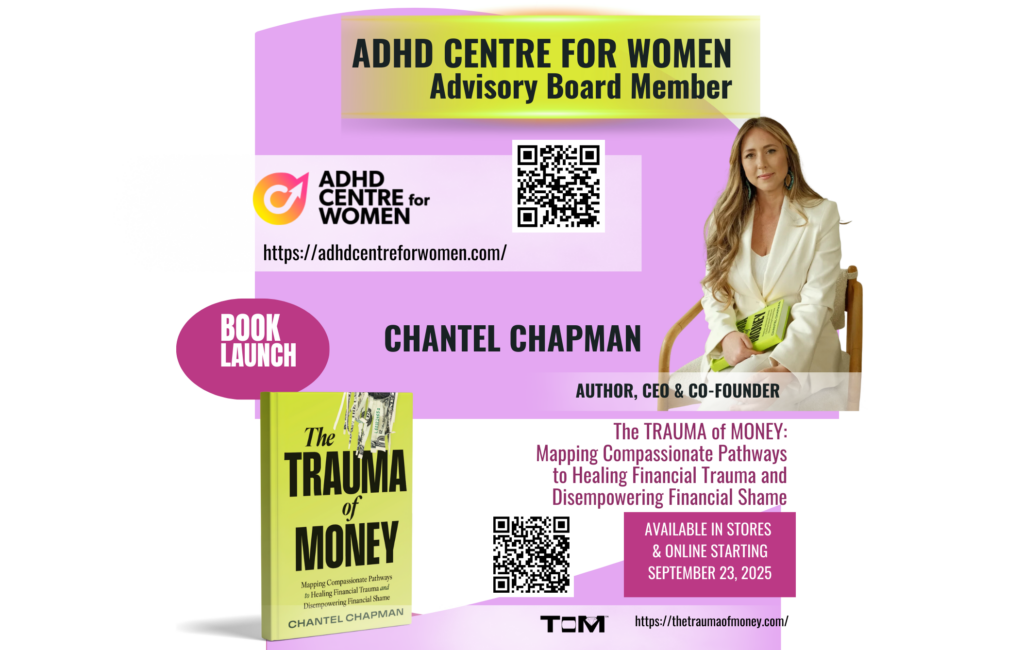
Chantel Chapman: ‘The Trauma of Money’ The ADHD Centre for Women is excited to announce the book launch of Advisory Board Member Chantel Chapman’s new release, “The Trauma of Money: Mapping Compassionate Pathways to Healing Financial Trauma and Disempowering Financial Shame.” This much-anticipated book will be available in stores and online beginning September 23, 2025. Discover how financial wellness and mental health intersect, and explore resources that support women with ADHD in overcoming financial shame. About the Author: Chantel Chapman Chantel Chapman is an influential voice in financial education and trauma-informed practices. As an Advisory Board Member and CEO, her work empowers women to better understand the emotional and psychological sides of money management, aligning with the ADHD Centre for Women’s mission to support holistic well-being. Book Overview: The Trauma of Money “The Trauma of Money” presents compassionate strategies for healing financial trauma and breaking cycles of financial shame. The book is especially relevant for women with ADHD, who may face distinct challenges around money and self-worth. By mapping compassionate pathways, Chantel provides actionable insights to help readers foster healthier relationships with their finances and themselves. Why This Book Matters for Women with ADHD Financial stress is a common struggle among adults with ADHD. This book offers targeted pathways to address financial trauma, build resilience, and create empowering habits. If you or someone you know is managing ADHD and wants a fresh perspective on financial healing, this launch shines a light on essential resources. How to Purchase and Learn More Grab your copy in stores or online starting September 23, 2025. For more details about the book and the author, visit: Optimize your financial health journey and support the ADHD Centre for Women’s commitment to empowering women today!